AI Tools That Manage Ads Beyond Content Creation 2026
Yes—4 tool types go beyond content creation: research, launch, monitoring, and analysis. Most teams need at least 3 to run paid ads well.

Key takeaways
- As of 2026, 34 percent of enterprise marketing teams run autonomous agents in production for ad operations rather than just copywriting.
- A high-performance advertising stack now requires specialized software to handle competitive research, live campaign launches, rule-based budget monitoring, and financial analysis.
What are the tools that manage ads beyond content creation?
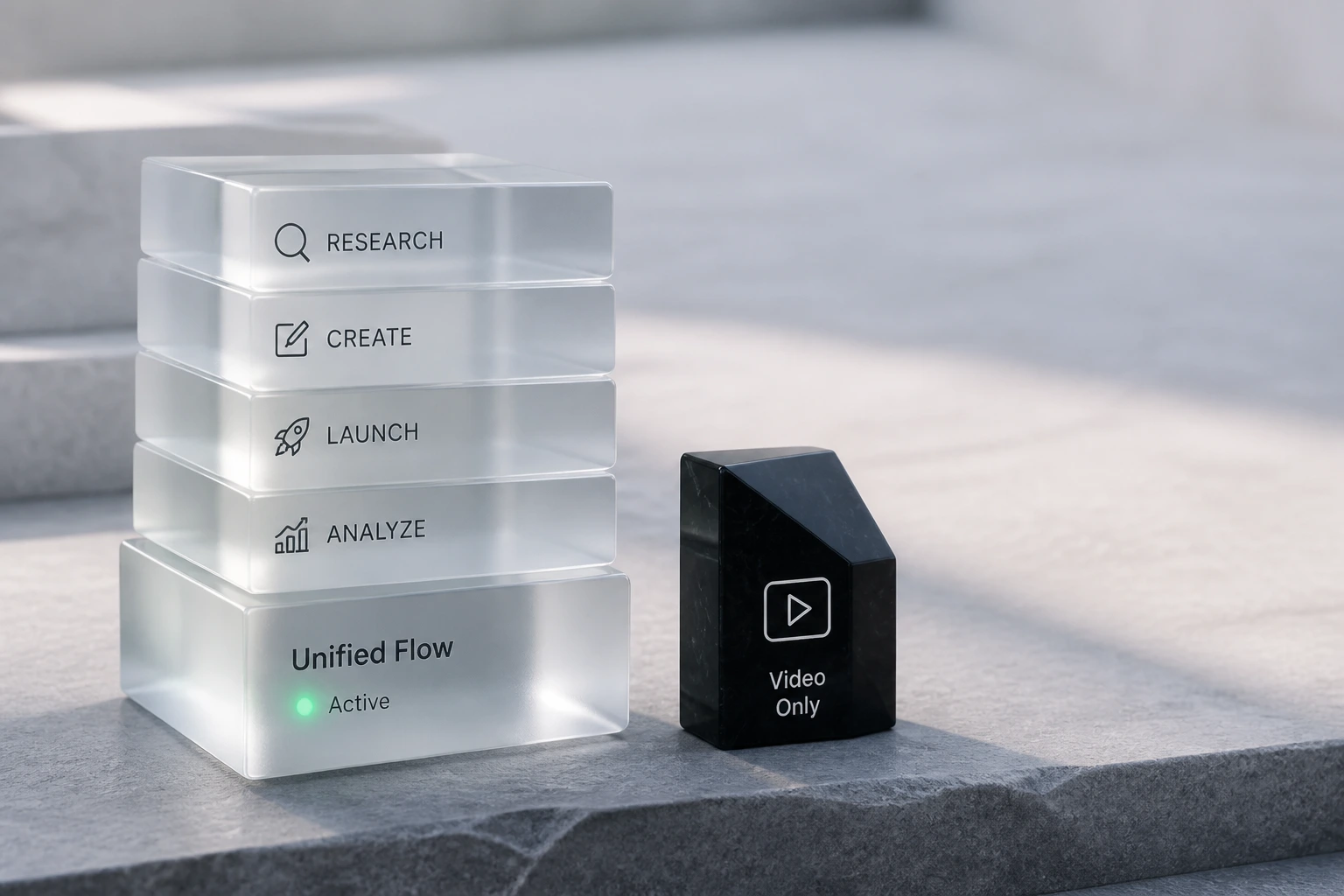
Four distinct artificial intelligence software categories govern advanced advertising operations: market research, autonomous campaign launch, rule-based monitoring, and cross-platform performance analysis. These systems execute actions directly inside advertising platforms rather than stopping at asset generation.
The marketing technology market has evolved rapidly beyond early iterations of generative text and image software. While basic content drafting applications still yield a 3.2x return on investment, operational tools for campaign analytics and reporting generate a 1.9x return on investment on their own (Digital Applied, 2026). Marketers achieve this by utilizing applications that perform direct "write operations" across Meta, Google, TikTok, and Snap ecosystems.
According to a 2026 Pipeboard analysis, the industry relies on four primary tool pillars:
- Research: Software like Playad Autopilot synthesizes competitor strategies and market intelligence instantly.
- Launch: Platforms like AdStellar and Pipeboard build and publish autonomous campaigns directly to ad managers.
- Monitoring: Rule-based engines such as Revealbot protect ad spend by automatically pausing underperforming variations.
- Analysis: Aggregation tools compile cross-platform attribution data to calculate precise return on ad spend (ROAS).
Playad analysis shows that limiting AI adoption to image and text creation leaves the most time-consuming account management tasks entirely manual, creating a bottleneck between asset approval and campaign deployment.
How do AI tools multiply marketer output across different workflows?
Marketers using generative AI save an average of 6.1 hours per week. This allows media buyers to shift their focus from manual data entry to top-level growth strategy.
By 2026, generative AI adoption among marketers reached 87 percent (Digital Applied, 2026). However, the output multiplier varies drastically depending on the depth of platform integration. Basic content tools generate assets, but campaign management platforms execute the actual buying and pausing logic.
Playad recommends evaluating ad technology based on the scope of operations handled autonomously.
| Tool Category | Core Function | Example Platforms | Workflow Integration |
|---|---|---|---|
| Content Generation | Drafts copy and generates isolated images. | Jasper, Canva | Manual export/import required |
| Campaign Layer | Executes "write" operations across networks. | Pipeboard, AdStellar | Direct API publishing |
| Monitoring & Rules | Automates budget pausing and scaling. | Revealbot | Rule-based account protection |
| Full-Cycle AI Team | Continuous loop of research, launch, and analysis. | Playad | Multi-agent autonomous workspace |
Teams that adopt multi-agent systems consolidate disparate marketing tasks. Instead of exporting a visual from a design tool, uploading it to Meta, and manually adjusting budgets daily, an integrated workflow handles the lifecycle continuously.
What is the setup time for autonomous ad platforms in 2026?
Modern artificial intelligence ad platforms deploy complete Meta campaigns in under 60 seconds using specialized autonomous agent networks. Speed of deployment has become the primary competitive metric for enterprise marketing teams evaluating new infrastructure.
AdStellar currently represents the benchmark for launch speed, taking a user from initial intent to a live, published Meta campaign in less than one minute (AdStellar, 2026). This bypasses the traditional multi-screen setup required within native advertising consoles.
For continuous workflows, Playad's Autopilot initiates onboarding using just a target website URL or existing competitor ads. By querying the Meta Ad Library and Google Ads Transparency center, the platform populates its internal workspace knowledge base instantly without requiring users to start from a blank canvas.
Rule-based automation tools require slightly different onboarding parameters. Revealbot remains the standard for budget protection with a 4.8 out of 5 rating on G2 (Pipeboard, 2026). Setup involves granting API access and selecting pre-configured automation "recipes" rather than building custom logic from scratch. Gumloop and Madgicx follow a similarly intuitive onboarding process, focusing on visual workflow builders that accommodate non-developers.
How does AI ad management impact ROI and agency pricing?
Artificial intelligence applications for campaign analytics deliver a measurable 1.9x return on investment, prompting 38 percent of US digital agencies to adopt outcome-based pricing models. The shift from hourly billing to performance compensation directly correlates with automated workflow efficiency.
As software takes over routine account maintenance, the traditional agency-client relationship structure is changing. Agencies are no longer billing for the manual hours spent uploading creatives or checking daily ad spend limits. Because practitioners save over six hours weekly (Digital Applied, 2026), that recovered time is reallocated to experiment design and market positioning.
Adoption of full-lifecycle automation is accelerating. While only 30 percent of organizations achieved fully integrated marketing stacks in 2025, 50 percent of the remaining firms expect to reach full AI integration across their campaign lifecycles by the close of 2026 (The Rank Masters, 2026). This transition signifies that tools managing ads beyond content creation have moved from experimental software to mandatory infrastructure for maintaining competitive customer acquisition costs.
Why do compliance and privacy laws dictate tool selection?
Automated advertising platforms must enforce compliance with comprehensive privacy statutes active in 20 US states during automated audience syncing and data analysis. Tools that perform write operations directly inside ad accounts carry higher regulatory requirements than isolated text generators.
As of May 2026, 12 states specifically require software to recognize and process Global Privacy Control (GPC) signals autonomously (Secure Privacy, 2026). Marketers deploying autonomous agents must ensure their systems respect these opt-out signals before automatically passing conversion data or syncing audience lists back to Meta and Google.
Platforms like Pipeboard and Revealbot undergo heavy scrutiny regarding how their analysis layers handle personally identifiable information. Because these systems execute programmatic decisions based on conversion tracking, they must strip user-level data while retaining enough aggregate signal to guide the optimization algorithms correctly. Choosing a platform with a certified compliance framework prevents automated agents from executing actions that violate state privacy statutes.
How do you choose the right AI tools for your ad stack?
A complete operational stack requires at least three integrated platform types to manage market research, direct deployment, and rule-based budget protection safely. Relying on a single generative application limits a marketing team's ability to scale paid acquisition.
To match the efficiency gains seen by top-tier enterprise teams, buyers should evaluate software based on daily operational coverage. A standard high-performance configuration in 2026 often includes:
- Playad for continuous competitive tracking, market-informed asset synthesis, and experiment design.
- AdStellar for rapid, sub-60-second campaign structure deployment (AdStellar, 2026).
- Revealbot to run 24/7 account monitoring and prevent budget bleed on underperforming variants (Pipeboard, 2026).
Implementing this multi-tool approach ensures the 6.1 weekly hours saved per practitioner translate directly into revenue-generating activities.
Automate your advertising stack
Connect your ad accounts and start automating your complete paid ad lifecycle with Playad.
FAQS
FAQ
What are the best tools that manage ads beyond content creation?
The four critical categories for managing ad operations include research, launch, monitoring, and analysis software. Platforms like Playad handle full-cycle workflow automation, while specialized tools like Revealbot manage rule-based monitoring with a 4.8 out of 5 G2 rating.
How do I find AI tools to multiply marketer output?
Look for platforms that execute direct "write operations" in your Meta and Google accounts rather than just drafting copy. Implementing autonomous agents for campaign management and analytics yields a 1.9x ROI and saves an average of 6.1 hours per week.
Where is the Revealbot quick setup guide?
Revealbot onboarding operates on an "if-then" framework across four major advertising networks. Users connect their accounts via API and activate pre-built automation recipes, such as automatically pausing any ad asset that drops below a 1.5 return on ad spend.
How does Gumloop ad automation onboarding work?
Gumloop prioritizes an intuitive, visual workflow specifically designed for marketing teams lacking in-house developers.
Does Madgicx offer the fastest setup for automated campaigns?
Madgicx offers a highly intuitive workflow using existing account data, but AdStellar currently leads the market in sheer deployment speed. AdStellar can launch a complete Meta campaign from initial prompt to live publication in under 60 seconds.
What is the typical AdStellar setup time?
Using its specialized autonomous agent networks, AdStellar completes full Meta campaign planning and execution in less than 60 seconds. This bypasses the manual configuration usually required inside native advertising managers.
How do users rate the best AI ad tools for ROAS on Reddit?
While Reddit communities debate specific feature sets, enterprise benchmark data confirms that full campaign lifecycle integration drives performance. By the end of 2026, 50 percent of firms that have not yet fully integrated expect to do so to maintain competitive ROAS thresholds.