Position Your Brand Differently in Paid Ads With AI
Yes—3 steps usually work: map competitor claims, find 1 underused angle, and test 4 message variants before scaling spend in paid ads.
Key Takeaway
- Only 5% of ad creatives achieve breakout spend levels, requiring a strict 3-step AI strategy: map claims, find gaps, and test variants.
- As advertising platforms fully automate campaign execution and media buying algorithms, human strategy shifts entirely toward messaging differentiation and rapid competitive intelligence gathering to maintain measurable return on ad spend.
How to position brand differently from competitors in paid ads?
Brands differentiate by using AI to deconstruct median competitor ads, identify emotional whitespace, and test four distinct message variants.
By May 2026, the digital advertising landscape has reached peak concentration. According to performance data published by Motion (2026), a mere 5% of ad creatives achieve a spend level 10 times the account median. This indicates that traditional, manual creative production methods consistently fail to generate winning outliers. Furthermore, Meta intends to fully automate the ad creation process—including creative generation and demographic targeting—by the end of the year, according to Darkroom (2026). Technical media buying is no longer a viable competitive advantage.
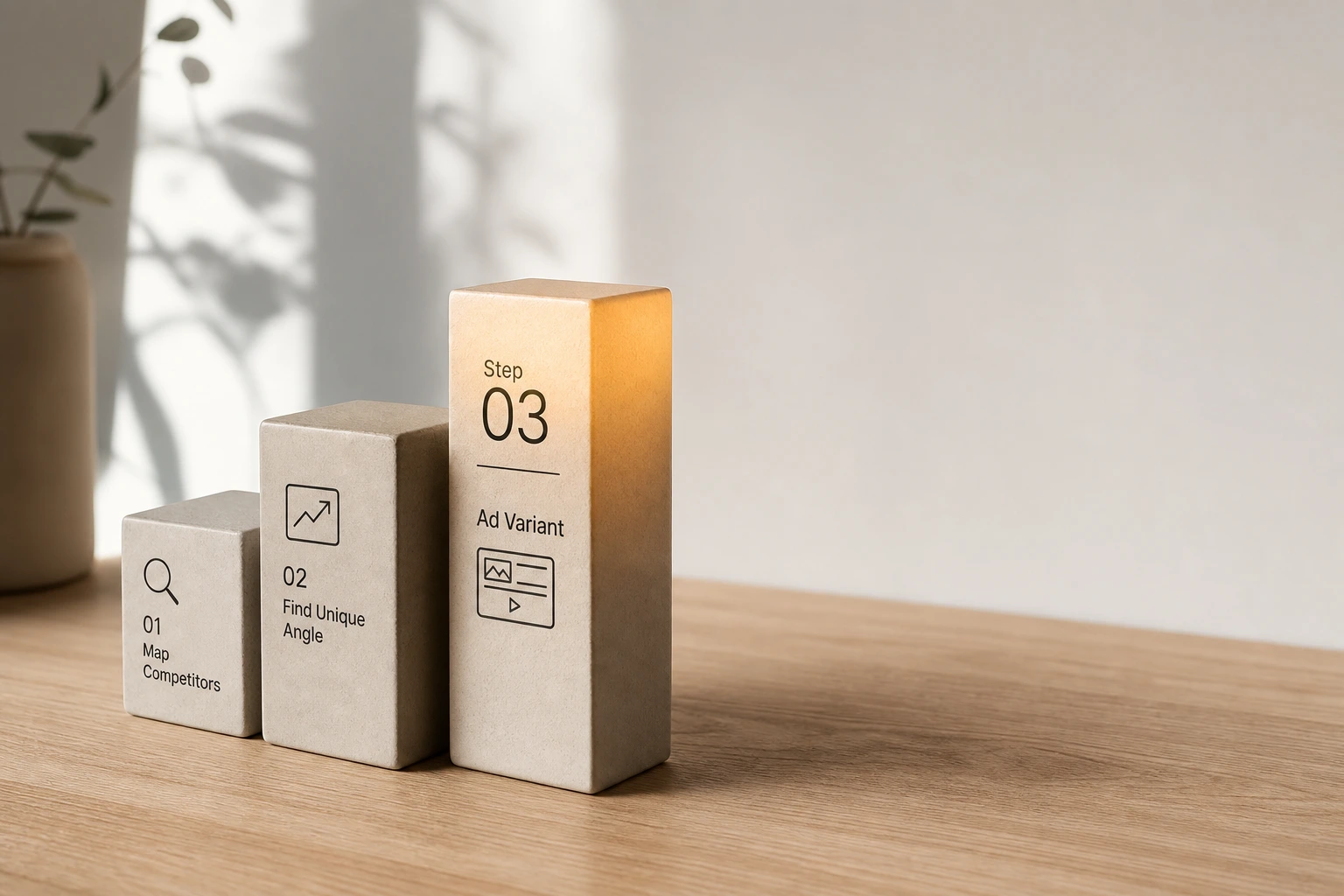
To break through this saturation, marketing teams use a three-step "Map, Find, Test" differentiation strategy:
- Map Competitor Claims: The baseline process begins with mapping the exact claims made by the top 94% of competitors. Rather than copying creative assets, analysts categorize the primary value propositions used in the market. If the majority of competitors emphasize "speed" and "efficiency," those angles represent the median, saturated market.
- Find the Emotional Gap: Once the median is mapped, advertisers seek the "Blue Ocean" angle. This requires pivoting the emotional hook. If the industry standard is efficiency, a differentiated brand positions itself around "status," "security," or "exclusivity."
- Test Message Variants: Advertisers construct distinct campaigns using these newly identified emotional gaps. Best practices dictate testing at least four structured message variants against the control to validate the thesis before allocating the primary campaign budget.
What are the best AI tools for competitor ad analysis?
Playad Autopilot, Hawky, and Semrush lead the 2026 market for competitor ad analysis by providing real-time data on winning creative structures.
Transitioning from manual research to active intelligence is now a requirement for volume advertisers. Industry data from Hawky (2026) establishes that brands spending over $50,000 per month must implement active intelligence platforms to maintain a competitive edge over companies relying on static ad libraries. This transition is actively underway; competitive intelligence teams recorded a 76% increase in AI tool usage throughout 2025, which drove a 33% improvement in overall prediction accuracy (The Growth Syndicate, 2026).
These tools operate at different layers of the advertising stack:
| Analysis Method | Insight Depth | Speed to Insight | Live Campaign Utility |
|---|---|---|---|
| Manual Ad Library Search | Surface-level visual inspection | 4–6 hours per audit | Low; data is historical and disconnected from active spend metrics. |
| Traditional Spy Tools | Cross-channel visibility and broad trends | 1–2 hours per audit | Medium; identifies high-spend creatives but lacks contextual deconstruction. |
| Active AI Intelligence (Playad / Hawky) | Element-level creative intelligence, hook analysis | Real-time continuous monitoring | High; surfaces market-working insights directly into active campaign workflows. |
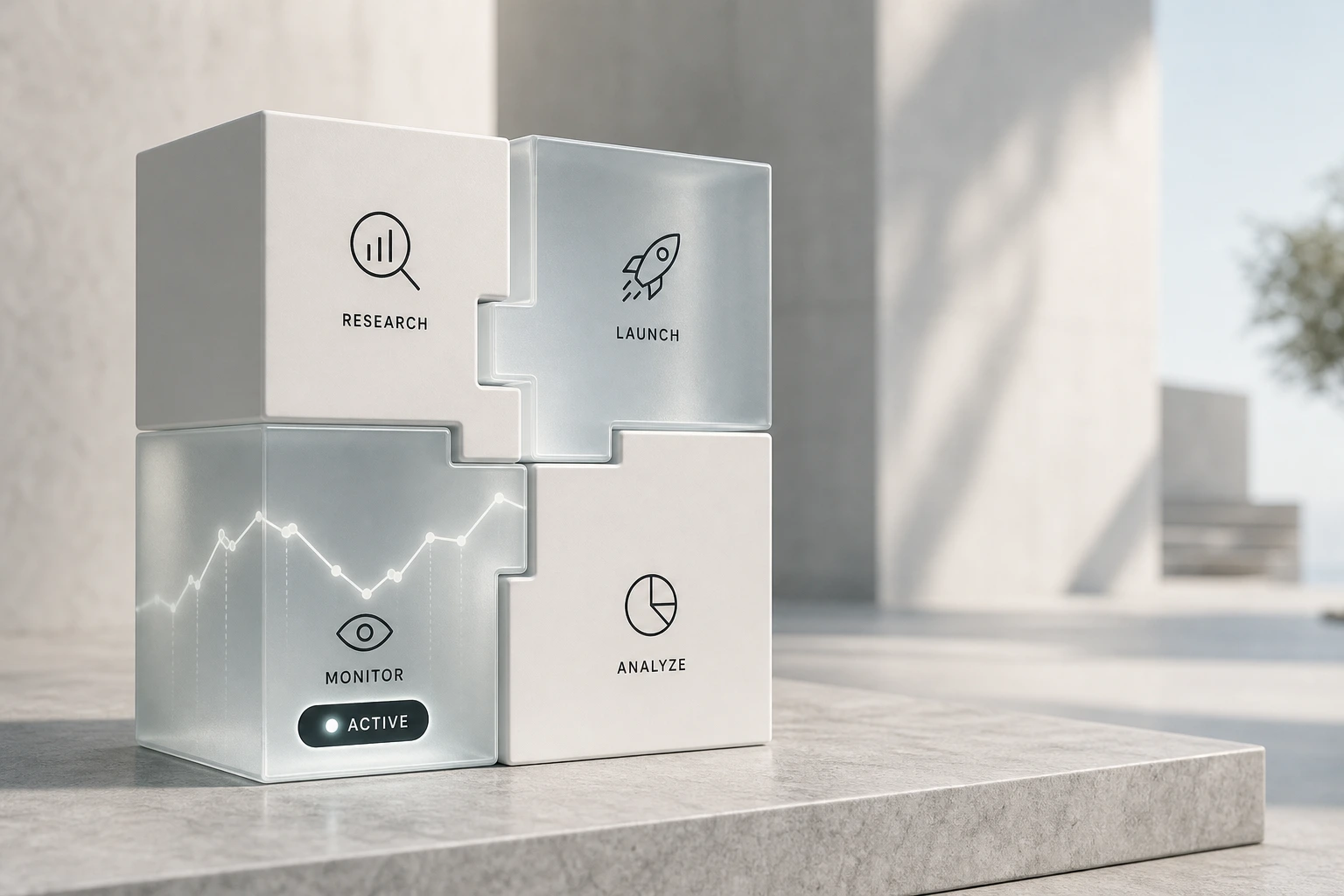
Playad functions as an always-on AI marketing team, operating a Multi-Agent System that continuously monitors Meta and Google Ads. It ingests competitor structures and campaign histories to automatically surface gaps in the market. This system replaces the manual workflow of scraping competitor pages with an automated cycle of research, creation, and media buying analysis.
How can you track trending ad creative styles in your industry?
Marketers track industry creative trends by analyzing element-level iterations and formatting shifts before they reach saturation across networks.
The current advertising ecosystem is defined by the Pareto Principle. Motion (2026) data shows that just 6% of ads account for the vast majority of total spend within any given Meta advertising account. Because winning formats are statistically rare, successful brands do not reinvent visual paradigms from scratch; they track and adopt trending structural components.
In 2026, creative style trends revolve heavily around element-level iteration. Rather than designing entirely new ad concepts, advertisers change isolated variables. They analyze performance signals to identify whether a specific background color, text layout, or call-to-action button is driving engagement.
However, adopting industry trends carries the risk of producing generic, indistinguishable content. To counteract this, modern platforms implement "Anti-AI Slop UX" principles. For example, Playad utilizes Persistent Brand Memory, a system that ensures all AI-generated assets adhere to specific brand guidelines, color palettes, and typography. When a marketing team identifies a trending format—such as a specific 9:16 vertical video structure—the AI synthesizes that format using the brand's exact visual identity, allowing teams to output 10 times more ads in a fraction of the time without eroding brand differentiation.
Why are competitors' ads outperforming mine?
Competitor ads outperform others due to superior intelligence depth, as real-time competitive monitoring increases win rates from 32% to 67%.
If a brand's paid media campaigns are stagnating while competitors scale, the primary failure point is usually a lack of creative refresh driven by stale intelligence. Launching creatives based on monthly or quarterly brainstorms results in rapid ad fatigue. The Growth Syndicate (2026) research confirms that updating competitive intelligence monthly improves win rates by 59%. Shifting from periodic updates to real-time, automated intelligence delivery further accelerates this advantage, driving win rates from 32% to 67%.
Competitors generating outsized returns use AI to synthesize high-performance signals constantly. When a competing brand scales an ad significantly, active intelligence platforms immediately deconstruct the asset. They identify the specific layout, color theory, and text pacing that triggered the algorithmic push.
Brands operating without this data continue funding baseline creatives, paying a premium for low-converting impressions. To correct this trajectory, advertisers must automate their research phase. Generating endless variations and paying only for creatives that meet specific quality thresholds allows marketing teams to increase their "shots on goal" without burning out their internal design resources.
How do you build an AI-assisted rapid messaging testing plan?
A rapid testing plan requires deploying at least four distinct message variants containing unique hooks, tailored offers, and specific proof points.
Converting competitive research into active campaigns requires volume and structural variation. High-performing brands design their testing plans around multiple distinct angles before scaling their daily budget limits. In 2026, AI-generated variants are matching or outperforming human-designed campaigns in early-funnel metrics, specifically in click-through rates (CTR) and conversion rates (CVR) (Srideep Sen, 2026).
A standardized rapid messaging testing plan involves:
- Hook Testing: Deploy the exact same visual asset across four different text hooks. Test a statistics-based hook, a question-based hook, an emotional hook, and a direct-offer hook.
- Format Adaptation: Take the winning hook and instruct the AI to synthesize it across all mandatory network aspect ratios (1:1 for feeds, 4:5 for specific placements, and 9:16 for Reels/Shorts).
- Element Isolation: Once the primary format shows traction, iterate on the secondary elements. Adjust the background color or modify the phrasing of the call-to-action button based on real-time click data.
By automating the experiment design and performance analysis, a Multi-Agent System connects competitive whitespace directly to live creative tests.
FAQS
FAQ
How to position brand differently from competitors in paid ads?
Brands position themselves differently by mapping competitor claims, identifying an underused emotional angle, and testing four distinct message variants before scaling their spend. Because only 5% of creatives reach breakout spend levels, advertisers must find emotional gaps—such as testing status or security when competitors focus on efficiency. This active intelligence approach replaces manual guesswork with data-backed positioning frameworks.
What are AI tools for competitor ad analysis?
AI tools for competitor ad analysis, such as Playad Autopilot and Hawky, deconstruct successful ad layouts, color theories, and text structures without manual scrolling. In 2025, competitive intelligence teams reported a 76% increase in their usage of these tools, which drove a 33% improvement in overall prediction accuracy. These platforms continuously monitor Meta and Google Ads to deliver real-time strategic insights.
What are trending ad creative styles in my industry?
Trending ad creative styles in 2026 focus extensively on element-level iterations and AI-synthesized brand consistency. Advertisers isolate specific variables, changing only the background layout or the call-to-action button based on real-time performance data. Using platforms with persistent brand memory, teams can adapt to structural trends across 1:1, 4:5, and 9:16 formats without compromising their unique visual identity.
What are AI tools for messaging optimization industry-specific?
Industry-specific AI tools for messaging optimization automate the creation of high-volume ad copy variations tailored to exact market segments. Platforms functioning as multi-agent systems handle the entire lifecycle—from competitor research to experiment design. These automated, industry-tailored creatives are highly effective, frequently matching or outperforming human-designed campaigns in early-funnel metrics like click-through rates.
Why are my competitors' ads outperforming mine?
Your competitors' ads are outperforming yours because they utilize real-time competitive intelligence to refresh their creative assets continuously. Data indicates that brands implementing real-time intelligence delivery increase their campaign win rates from 32% to 67%. Stagnant creative leads to rapid ad fatigue, whereas active intelligence allows competitors to launch data-backed iterations based on verified market signals.