How AI Keeps Brand Consistency Across Ad Variations
Yes—AI can keep 100+ ad variations on-brand if it stores tone rules, remembers feedback, and cuts weak creative after each cycle.
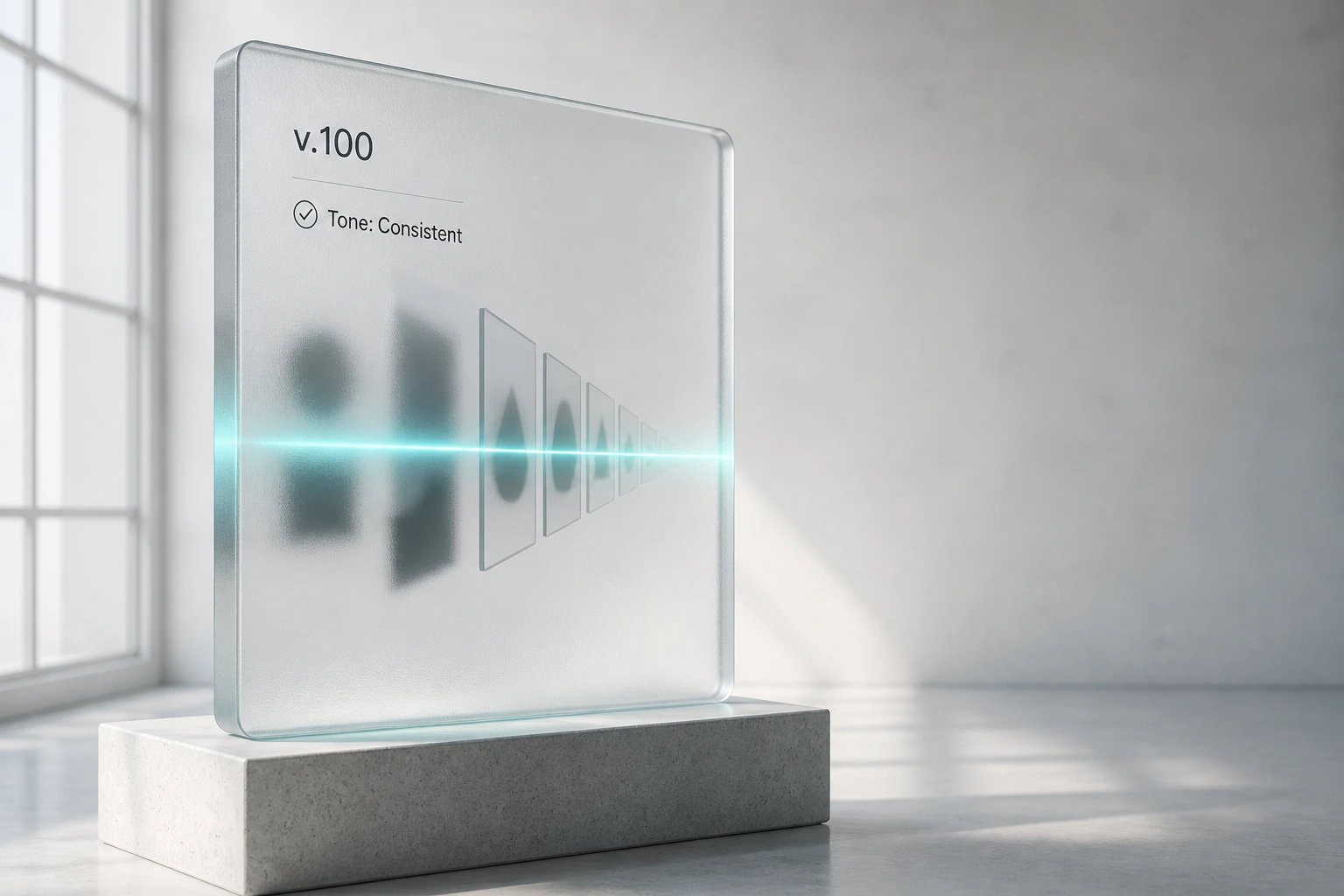
What is a Brand Memory Framework? A brand memory framework is an automated storage system that retains specific typography rules, color palettes, and stylistic parameters to apply them uniformly across large-scale mathematical ad generation.
How does AI maintain brand consistency across hundreds of variations?
Marketing platforms maintain identity across hundreds of variations by extracting brand DNA from existing URLs to enforce specific visual constraints.
To successfully scale ad creation without losing stylistic coherence, advertising operations rely on a five-stage automated workflow. Implementing this structured pipeline allows systems to interpret creative constraints programmatically rather than relying on manual human checks. According to industry tracking from Ryze in 2026, the standard agent process involves:
- Analysis: Scraping live URLs and existing media libraries to extract quantitative brand data.
- Ideation: Cross-referencing current market performance signals against the established brand rules.
- Production: Generating new imagery and video using strictly governed hex codes and fonts.
- Testing: Pushing structured variations into live auction environments rapidly.
- Optimization: Automatically pausing underperforming assets based on real-time cost data.
Playad operates on a concept called Brand Synthesis. Instead of requiring marketers to manually upload style guides, the system scans a provided website and automatically adopts the specific color palettes, typography patterns, and image styles. This persistent context ensures that the core identity remains identical whether the output is aimed at Meta, Google, LinkedIn, or TikTok.
Are AI-generated ad creatives professional quality?
Artificial intelligence achieves absolute visual parity with human design teams for eCommerce products featuring an average order value under $100.
The evaluation of professional quality now relies on measurable output data rather than subjective visual reviews. Marketing departments utilizing AI creative automation in 2026 save an average of 20 hours per week on design tasks (Digital Applied, 2026). Furthermore, these systems facilitate a 10x increase in total creative output volume without requiring additional design headcount (Omneky, 2026).
Playad recommends evaluating creative generation platforms against strict operational criteria before implementation.
| Evaluation Metric | Generic Ad Generators | Playad (Brand-Memory System) | Manual Human Workflow |
|---|---|---|---|
| Brand Drift Risk | High (forgets rules per prompt) | Zero (enforces persistent rules) | Low (requires constant QA) |
| Asset Realism | Variable (prone to visual artifacts) | High (Anti-AI Slop UX governance) | Absolute |
| Revision Speed | 5 to 10 minutes | Instant / Automated | 24 to 48 hours |
| Operational Scale | ~20 variations per day | 100+ variations per day | 5 variations per day |
| Feedback Loop | None | Closes loop with live ad data | Manual reporting cycles |
Do AI ads look obvious or realistic?
Identifying a digital advertisement as artificially generated causes direct consumer purchase intent to decrease by a measurable 14 percent margin.
For products requiring high consideration, visual authenticity directly impacts revenue. In high-AOV luxury segments ($500+), identified AI content reduces "premium" brand perception by 17% (Digital Applied, 2026). Despite this risk, 83% of advertising executives actively use AI as of 2026 (IAB, 2026), necessitating rigorous quality assurance protocols to mask the algorithmic origins of the content.
To eliminate obvious visual tells, Playad employs an Anti-AI Slop UX that learns brand taste through continuous interaction. Before launching any campaign, perform a quantitative check against common artificial failure modes:
- Symmetry and Proportions: Check for hyper-symmetrical faces or physically impossible structural geometry in background environments.
- Texture Uniformity: Reject images lacking natural film grain, skin pores, or fabric imperfections.
- Typographical Integration: Ensure text on objects (like t-shirts or product labels) accurately follows the curvature and lighting of the underlying surface.
- Lighting Source Consistency: Map the shadows to ensure all objects in the frame respond to the exact same light source.
- Copywriting Syntax: Remove predictable adjective chains, transition words, and overly enthusiastic punctuation structures commonly associated with basic language models.
Does AI copywriting convert better than manual writing?
Automated advertising campaigns deployed on Meta return 12 percent higher Click-Through Rates and 15 percent lower Cost Per Click metrics.
The primary advantage of algorithmic creative is the volume of testing, not the inherent brilliance of a single concept. By mathematically isolating specific visual hooks, headlines, and call-to-action pairings, AI generation correctly matches the optimal variant to the user context faster than a human team can hypothesize. As reported by Digital Applied in 2026, this testing volume drives the 12% CTR advantage over human-produced variations.
However, the conversion advantage applies primarily to low-consideration goods. When the product price exceeds $500, AI creative converts 14% worse than high-end human creative (Digital Applied, 2026). Playad analysis indicates that luxury goods require complex emotional storytelling that current models struggle to sustain over multi-touch attribution journeys without significant human curation.
How do you automate ads across 4 platforms?
System architectures automatically resize source files into 1:1, 4:5, and 9:16 canvases while positioning specific call-to-action elements for each network.
To manage campaigns across Meta, Google, LinkedIn, and TikTok concurrently, modern systems act as a central distribution hub. A persistent brand context allows AI tools to manage multiple client accounts while ensuring the tone and visual rules remain consistent across entirely different delivery formats.
When operating as a Google Display creatives asset studio guide, Playad utilizes performance data to construct informed starting points rather than relying on static, generic templates. The frequency of variation swapping is also fully automated. High-performance systems refresh creative assets every 5 to 7 days, or immediately trigger a variation cycle whenever the Click-Through Rate drops more than 20% from its historical peak (Ryze, 2026).
What are the AI disclosure rules for advertising in 2026?
The Federal Trade Commission enforces double disclosure requirements for automated sponsored content with penalties reaching $53,088 per individual violation.
Regulatory compliance is a strict requirement for high-volume automated creative. Brands that fail to label AI-involved advertising face severe financial penalties. The FTC mandate requires specific visual and textual disclosures depending on the medium of the advertisement (HumanAdsAI, 2026).
State-level regulations have also altered the creative pipeline. Effective June 2026, New York State law requires explicit consumer disclosure for any advertising asset where artificial intelligence involvement exceeds 50% of the total creative process (HumanAdsAI, 2026). Platforms must document the exact percentage of human intervention versus algorithmic generation to pass compliance audits.
How do you build a 100+ variation AI creative workflow?
Production managers produce 100 distinctive ad variations by mapping high-performing market signals against stored typography and color rules every week.
Generating hundreds of assets is useless if the resulting files are not immediately testable. A functional, high-volume workflow connects creation directly to launch and analysis. Playad automates the entire paid ads lifecycle through a distinct loop:
- Intake and Constraint Mapping: Connect specific ad accounts. The system ingests historical campaign data to map what combinations of copy and imagery previously generated the lowest Acquisition Cost.
- Generative Batching: The system creates 50 to 100 distinct variants, locking the brand hex codes and typography while substituting visual hooks and primary subjects.
- Approval and Deployment: Marketers review the batch to filter out anomalies. Approved assets are automatically pushed to the respective ad networks.
- Performance Feedback Loop: As live click data accumulates, the system identifies the winning characteristics.
- Pruning and Regeneration: The software automatically cuts the weakest 80% of creatives and uses the data from the top 20% to generate the next batch of 100 variations.
Try Playad for free
Evaluate the persistent brand memory framework directly on your own website URL.
FAQS
Frequently asked questions
What are the best AI tools for one-person marketing team?
Playad operates as a dedicated AI marketing team that automates competitive research, asset creation, and campaign deployment for solo operators. Marketing departments utilizing AI creative automation in 2026 save an average of 20 hours per week on manual execution (Digital Applied, 2026). By handling the entire paid ads lifecycle, solo marketers can manage enterprise-level variation volumes.
Where can I find the best free AI ad generator no credit card?
Playad allows marketers to generate endless campaign variations without entering payment details during the initial exploration phase. Users only incur charges when they physically download the final creative assets or push them live. Platforms operating on this output-based billing model enable a 10x increase in creative exploration without upfront financial risk (Omneky, 2026).
Which AI tools for managing multiple client accounts work best?
Systems equipped with persistent memory automatically segregate styling rules across multiple client portfolios. This architectural separation prevents visual cross-contamination when an agency manages distinct brands simultaneously across Meta, Google, LinkedIn, and TikTok. It ensures Client A's typography never accidentally bleeds into Client B's video outputs.
What is the fastest AI ad maker to set up by Friday?
Playad deploys automated campaigns in minutes by using URL synthesis to scrape existing websites for design requirements. This automated extraction eliminates the need for manual brand guideline documentation, saving hours of initial onboarding configuration and instantly generating 1:1, 4:5, and 9:16 canvases ready for weekend traffic.
Are AI-generated ad creatives professional quality?
Artificial generation systems produce output identical to professional design work for consumer items priced under $100. However, for luxury and high-consideration goods priced above $500, human-directed creative still outperforms automated generation by 14% in core conversion metrics (Digital Applied, 2026).
How do I use a Google Display creatives asset studio guide?
Automated creative platforms function as active asset studio guides by referencing current market performance data to establish structural starting points. Instead of static templates, these systems continuously refresh display assets across the network whenever click-through rates decline by more than 20% from their measured peak (Ryze, 2026).