ROAS Dropping Despite Increased Spend? 7 AI Checks
If ROAS falls after spend goes up, check 7 signals first: audience saturation, creative decay, bid mix, landing-page mismatch, and daily alerts.
Why is ROAS dropping despite increased spending?
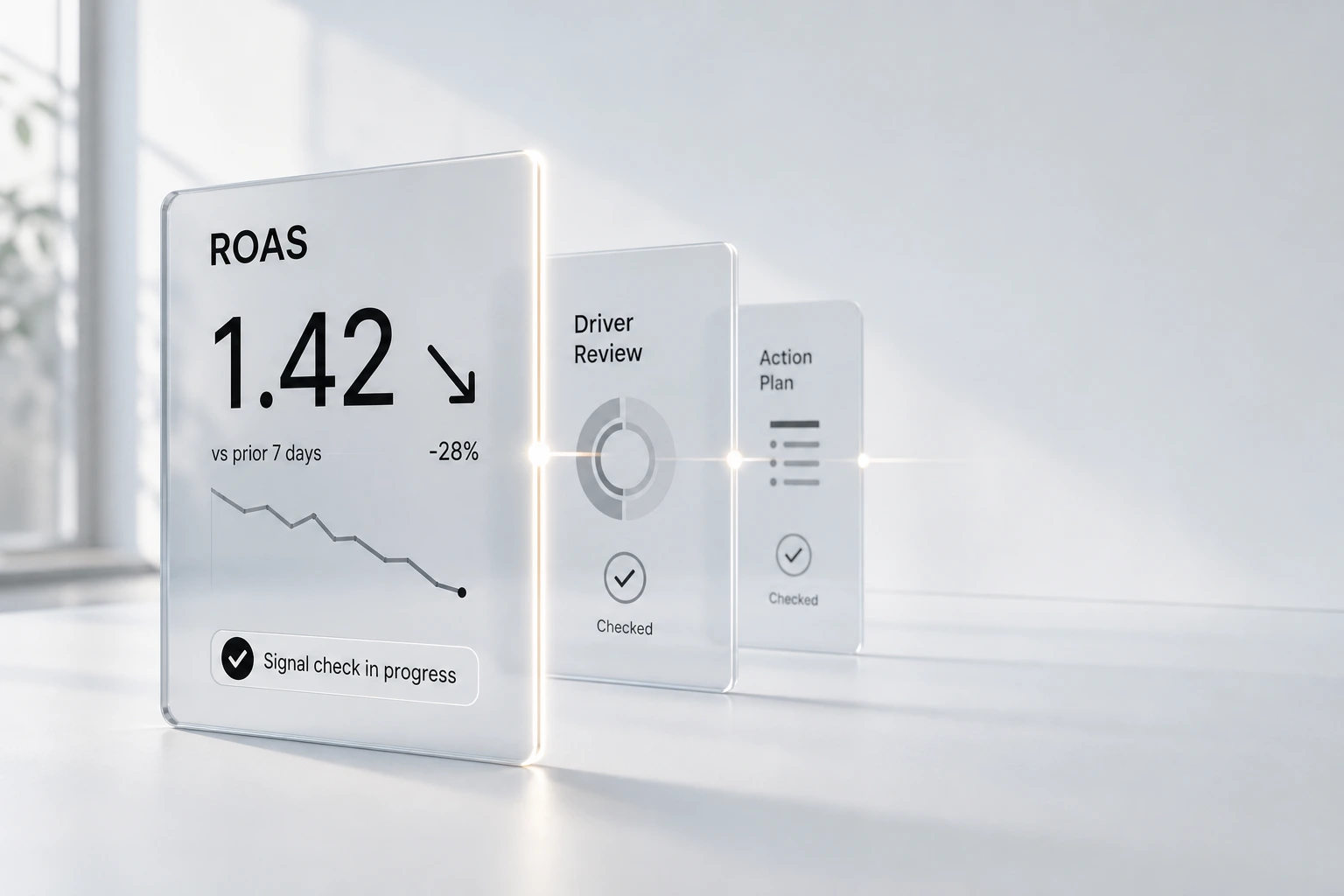
Ad accounts experience a 23% average drop in ROAS when aggressive budget scaling triggers algorithmic learning phase resets and CPM penalties. This decline is rarely a bidding error; it is a structural failure between targeting signals, creative distribution, and campaign feedback loops.
When budget increases correspond with a sudden drop in returns, advertisers must diagnose the account systematically rather than making reactive bid adjustments. Based on the 2026 platform architecture shifts, here are the seven required checks:
- The 50-Conversion Penalty: Meta's shift to outcome-based optimization penalizes campaigns lacking sufficient data. Campaigns registering fewer than 50 weekly conversion events are systematically deprioritized by the delivery algorithm, triggering higher CPMs. Verify your event volume immediately.
- Velocity Exceeding the 20% Threshold: Spending increases greater than 10–20% within a 2-3 day window destabilize AI bidding logic. According to Tailored Edge Marketing (2026), exceeding this strict scaling increment causes "performance shocks" that erase the efficiency of lower-spend baselines.
- The 3-Week Creative Wall: High-spend campaigns exhaust their audience pools at an accelerated rate. Platform distribution now requires a complete creative refresh every three weeks to maintain auction visibility.
- Optimization Goal Mismatch: Ensure campaigns optimize for "Sales" or "Leads" rather than top-of-funnel "Traffic." The March 2026 algorithm prioritizes downstream conversion predictions, actively punishing accounts relying on engagement metrics with a 15–40% CPM penalty, as detailed by Digital Applied (2026).
- Lack of Daily Performance Summaries: Waiting for weekly or monthly reporting allows ROAS to bleed. Teams missing daily synthesis fail to catch and correct anomaly patterns in CPM and CPC within the critical 24-hour window.
- Market Intelligence Blind Spots: Ad accounts operate in competitive auctions, not vacuums. If your campaign fails to adapt to competitor positioning changes detected in the Meta Ad Library or Google Ads Transparency center, your increased spend merely buys expensive, low-converting impressions.
- Landing-Page Mismatch: Scaling spend brings broader audiences to the landing page. If the creative messaging diverges from the site's offer, bounce rates spike and the algorithm registers negative user experience signals, further restricting ad delivery.
How does AI targeting work for ads?
Modern AI ad targeting utilizes autonomous agent layers built on frameworks like the Google ADK to predict downstream conversion probabilities rather than grouping static audience interests. The platform algorithms ingest user history, session data, and predictive modeling to match impressions with the highest probability of an exact conversion event.
The fundamental shift in 2026 advertising is that platform AI no longer guesses interests based on page likes; it calculates intent based on behavioral velocity. However, platform algorithms cannot fix poor input quality. If an advertiser feeds the system only three ad creatives, the AI will force spend into the best of those three options—even if all three are objectively poor performers.
This dependency on input volume is why external AI marketing systems are necessary. A system like Playad's Autopilot functions as an active agent layer. It monitors the broader market conditions, synthesizing competitor data to formulate experiment designs. Real-time personalization executed by AI layers generates a 30% higher ROI within 18 months of implementation, according to data from RZLT (2026).
The platform's internal AI handles the bidding and the placement. The external AI marketing team—Playad—handles the research, the market intelligence, and the continuous generation of 20–50 creative variations per campaign to feed the platform algorithm the raw material it needs to optimize delivery.
What makes an AI tool a strategic marketing partner?
AI-powered marketing agencies deliver 25–45% higher ROI and 25–35% cost savings compared to traditional agencies by automating continuous creative testing and launch cycles. A true strategic partner moves beyond generating isolated text snippets and assumes responsibility for the full campaign lifecycle.
Most marketing software falls into fragmented categories: reporting dashboards that highlight problems but offer no fixes, or image generators that produce assets lacking brand context. A full-cycle AI marketing team operates differently. Playad, for example, utilizes a multi-agent system to handle research, creation, launching, and analysis simultaneously. By analyzing a company's website URL, the system's brand synthesis automatically extracts color palettes, typography, and image styles, ensuring generated assets remain brand-compliant at scale.
This compression of the production timeline fundamentally changes campaign economics. While traditional production requires weeks, AI agencies compress launch times to 1–3 days, as reported by The Hovi (2026).
| Capability | Reporting Dashboard | Creative Generator | Full-Cycle AI Partner (Playad) |
|---|---|---|---|
| Diagnosis | Highlights ROAS drops | None | Synthesizes daily performance alerts |
| Execution | None | Produces isolated assets | Launches 20-50 localized variations |
| Learning Loop | Passive observation | None | Feeds ad data into next creative cycle |
| Daily Usefulness | Metric tracking only | Manual prompt required | Proactive alerts and scheduled summaries |
| Brand Adherence | N/A | Requires manual training | Automated URL-based brand synthesis |
How to recover ROAS within 72 hours?
Fixing a declining ad account requires restricting budget increases to 10–20% maximums and injecting 20–50 new creative variations to reset auction distribution. Advertisers must halt erratic manual adjustments and implement a strict mechanical workflow.
Playad recommends executing the following 72-hour recovery sequence when increased spend causes a performance collapse:
Day 1: Threshold and Velocity Audit Review every active campaign for the 50-conversion minimum. Pause campaigns optimizing for "Traffic" and consolidate ad sets to pool conversion data. Next, audit your change history. If you scaled budgets by 40% two days ago, you have triggered a learning phase reset. Roll the budget back to the last known efficient baseline and implement a rigid 10–20% increase limit scheduled every 48 hours.
Day 2: Break the Creative Wall Evaluate ad frequency and creative age. If your top-spending ads have been active for more than three weeks, they have hit the creative decay wall. Use an AI agent to generate new angles. Playad produces 10x more ads in 100x less time, allowing advertisers to instantly inject 20–50 fresh variations into the account, providing the platform AI with new hooks to test against saturated audiences.
Day 3: Feedback Loop Implementation Configure proactive alerts for daily performance summaries. Review the data returning from the new creative injection to isolate which messaging angles generate the lowest CPCs. Feed this specific data back into the creation engine to spawn the next generation of ads.
What are the current ROAS benchmarks by industry?
Software companies lead with an 8.2:1 median ROAS as of 2026, while ecommerce brands average 2.87x and real estate operators see 1.8:1 returns. Before diagnosing an account failure, advertisers must verify if their performance expectations align with the current market reality.
Rising CPMs and platform changes have altered baseline returns across sectors. The 2026 data from Improvado highlights the stark contrast between digital products (SaaS at 8.2:1) and high-friction physical assets (Real Estate at 1.8:1).
Meanwhile, ecommerce accounts face distinct headwinds. As of 2025, ecommerce ROAS saw a 4% year-over-year decline directly tied to escalating auction competition and CPM inflation, according to Rule1. Advertisers in these sectors cannot rely on static campaigns to beat declining averages; they require automated testing volume.
If paid channel returns remain fundamentally capped by industry constraints, resource reallocation becomes necessary. Rule1 (2026) notes that B2B SaaS SEO delivered an 8.75x ROAS compared to a 1.70x return for PPC in the same period, suggesting that when paid ads reach maximum efficient scale, parallel organic channels must absorb the remaining budget.
FAQS
FAQ
What are the best AI tools for daily performance summaries?
Playad is an AI marketing team that automates daily performance summaries by extracting data directly from Meta and Google Ads. It uses a multi-agent system to monitor campaign history and competitive environments, delivering proactive alerts and synthesizing what is working in real-time, reducing the need for manual dashboard monitoring.
How does AI targeting work for ads?
Platform AI targets users by predicting downstream conversion probabilities rather than matching static interests, utilizing deep behavioral data to find buyers. External AI targeting systems, like Playad's Autopilot built on the Google ADK, feed these platforms by researching competitor intelligence and generating 20–50 creative variations to optimize the algorithm's delivery.
How do I choose an AI tool strategic marketing partner?
Select a partner that operates a closed learning loop, automating research, creation, launch, and analysis in one system. Data from 2026 indicates that AI agencies utilizing this full-cycle approach compress campaign launch times to 1–3 days and yield 25–45% higher ROI compared to traditional marketing models.
Why is my ROAS dropping despite increased spending?
ROAS drops during scaling because budget increases exceeding 20% reset the algorithm's learning phase, while a lack of creative volume leads to rapid audience saturation. In 2026, campaigns also face severe CPM penalties if they fail to register 50 weekly conversion events due to platform outcome-based optimization rules.
What is the maximum amount I should scale my ad budget?
You should restrict budget scaling to 10–20% increments every 48 to 72 hours. Exceeding this exact threshold disrupts the AI bidding logic, causing performance shocks that force the platform to relearn user behaviors at a much higher cost per acquisition.
Recover your ROAS today
See how Playad Autopilot generates 50 localized ad variations for your campaign to optimize performance and scale efficiently.